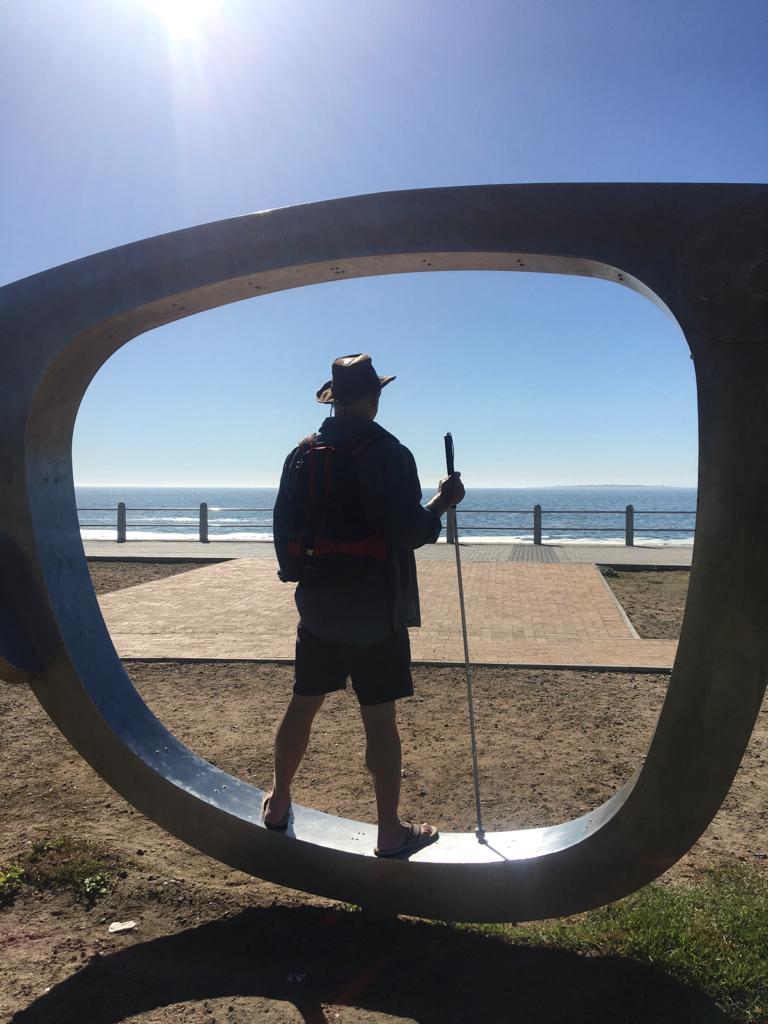
“Wow! Look at that,” my wife says.
“Look at what?” I say, expecting some sort of explanation of a visual image.
“There is a guy hanging off the sunglasses!”
Wait… what! Sunglasses! “What do you mean he is hanging off the sunglasses?”
“You know,” she says.
“The sunglasses sculpture.”
“No, I don’t know,” I say.
“What sunglasses sculpture?”
“But they have been here for ages,” she says.
“No, I didn’t know…”
“Can we go over and see?” I say.
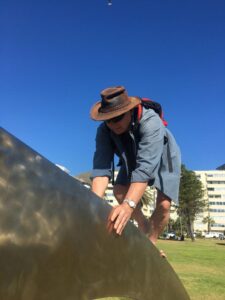
And we did, and I spent a wonderful hour peppering them with questions and examining and climbing over every inch of one of the most memorable sculptures I have ever been made aware of.
And that is the crux of this essay and others that will follow on this theme.
What we miss.
As blind people, it is so easy for us to miss a great deal, unless there is some way of bringing to our attention what is clearly visible to you sighted folks.
The thing is that you take so much of the huge amount of visual data that pours into your eyes for granted, and you sort things out accordingly. This might mean noticing but not really engaging with visual stuff that you see or have seen before, and putting it into the box labelled “seen already”. You will probably remember it and will be able to refer to it later if called upon to do so, but it will have been further refined to retain only the important stuff, particularly important to you.
So, for my wife and friend on that day in Sea Point, if it hadn’t been for that chap climbing all over it, which is what caught my wife’s eye, it is likely that I might still not have known about the amazing stainless steel sculpture of a giant pair of sunglasses called “Perceiving Freedom” by local sculptor Michael Elion, and which had been standing on the grass verge of the Sea Point promenade since 2014. (one cant help but smile at the irony of the name and depiction of sunglasses, in the context of blindness)
Since then, I have become increasingly aware of what we miss as blind people. Without wanting to sound resentful, it is rather scary and sad to think what I might have missed in my six decades as a visually impaired and blind person.
Which is why I am spending far more time nowadays quizzing those long-suffering people I meet, about what is around me and is in their visual orbit.
Enter the wonderful science and art form of audio description.
It is unrealistic for us to assume or expect that you sighted people will simply transmit every visual image you see to us in some way.
However, what would be great is if you would think a little more about what we might be missing and bear that in mind when you see something interesting and you happen to be with a person with a visual impairment.
At the same time, I believe the onus is on us as blind people to be more curious and ask more probing questions about our surroundings. We cannot be blamed for not seeing something in our immediate environment, but we can ask those who can see, far more than I suspect we do.
Which leads us back to how one might best employ the wonderful art of exciting and immersive audio description.
This is not the place to go into a lecture on the growing applications of this wonderful science, which can make a huge difference in blind people’s appreciation of media such as film, theatre, art, heritage, tourism, game viewing, dance, and sport, to name but a few.
Far more qualified people than I have written extensively on the subject.
Suffice to say that it can be a rewarding and enlightening experience for a sighted person to put some effort into describing something to a visually impaired or blind person. Particularly if the blind person is engaged and interested in the subject.
Better still if the description becomes a dialogue and a dynamic conversation.
For professionals whose job it is to show people around in whatever genre of media establishment you work in, your challenge is to notice who might require more input and to move away from that dreaded line: “As you can see.” And to rely less on your patter and learn to apply the magic of audio description way more than you might.
An important note to remember here: far more people than you might think have less than perfect vision, and although they might appear to manage adequately, they often struggle to see things at a distance or in detail or in the dark.
In future posts, I intend to share some more insights into specific examples drawn from my own experience, including the wonders of the tactile experience.
In closing, an important shout-out to my friends and colleagues at Shazacin Accessible Media, who have done more to raise the flag for audio description in South Africa, particularly in the local film industry, than any other entity.
For a full audio description of the brilliant sunglasses sculpture “Perceiving Freedom” by Michael Elion, click here. (If you haven’t already signed up to describeAT you will need to sign on, or contact app@shazacin.com,)
Finally click here to see the webinar I gave on ‘The things we miss. Making a case for audio description and the wonders of the tactile experience in June 2024.
https://www.youtube.com/watch?v=VSHEXj4jL84