Welcome to the third edition of “The Things We Miss”, a column where I share audio descriptions of interesting sculpture or structures, or anything noteworthy.
Usually, as a blind person, I miss interesting features simply because I don’t see them or someone hasn’t mentioned or described the thing to me.
However last year in April 2024 I had every intention of not missing something that I had wanted to see for ages.
It was the Bean or Cloud Gate as it is also known, the famous large interactive sculpture in Chicago, created by British Indian sculptor Anish Kapoor between 2003 and 2004.
Alas, just my luck, it was closed for maintenance at the time, so I missed out on seeing it.
But luckily, last week, on May 20th, 2025, while visiting Chicago again, I got a second chance.
My friend, Pieter, and I caught the train in from Evanston to Chicago city centre. It was bitterly cold as we walked down Michigan Avenue, which takes one to Millenium park where the Bean is located.
At first, while still walking, Pieter was not terribly enthusiastic about the Bean, thinking it was unlikely that a sculpture of a large bean would be very interesting. In fact, this had been my own thought a year ago, before my daughter impressed upon me that I absolutely had to see it and that I would not regret it.
So, huddled against the cold we entered into Millenium park. Pieter drew up and said “Wow! I didn’t realise it was so big!”
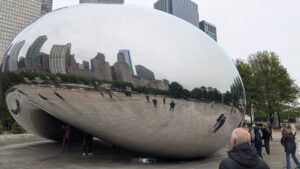
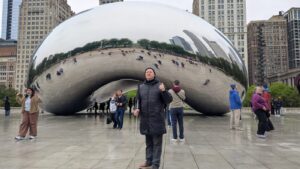
Indeed, it is really huge, standing 10 metres high (33 feet) and 20 metres long (66 feet) and 13 metres (44 feet) wide. It is as big as a large double-storey house.
I am always a little conflicted at time like these when facing such a large structure and not being able to see it.
I feel part-envious and part-disappointed and yet am still able to be vicariously awed when I am with others, as long as they voice their appreciation .
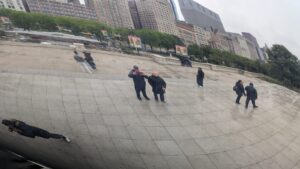
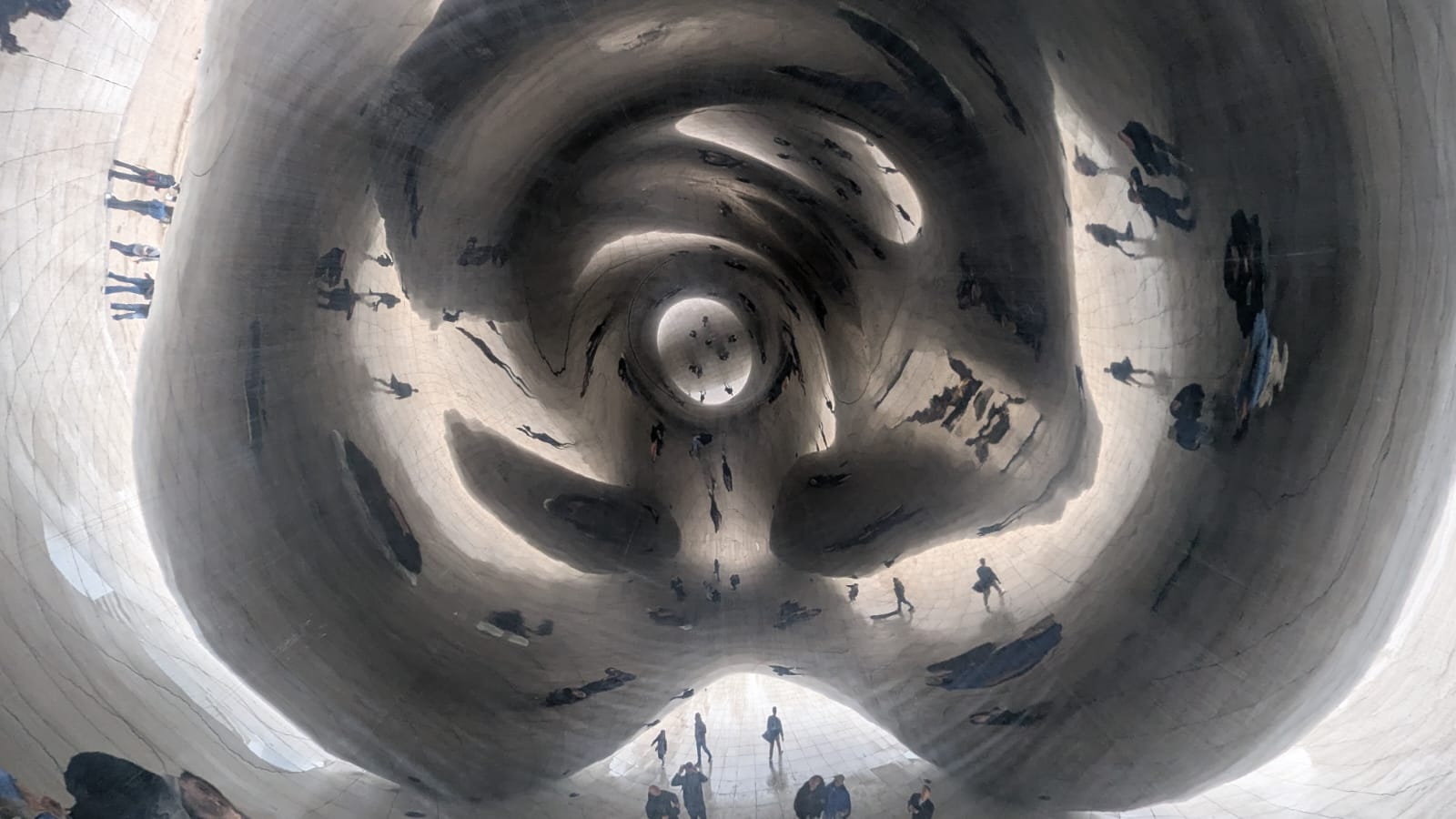
As its name implies, the Bean is shaped like a kidney bean, or perhaps a jelly bean. It stands on its two ends with its broad, curved back facing the sky, thus opening up a cavernous area underneath it. This area is known as the navel.
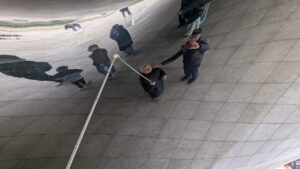
This was my first impression of its massive scale as, standing underneath it, I was barely able to touch the underside with my cane. (I just managed, as you’ll be able to tell from one of the pictures, herewith.)
It was a genuine shock when my friend urged me to touch it, once we had approached and got close to its side. To say it was smooth is a hopeless understatement. It is hard to imagine that something so big could be as smooth and polished to the touch. I suppose the closest I could come to a comparison would be feeling the fine curve of a highly polished car … but even smoother!
One is immediately filled with wonder at how on earth they could have got this mirror finish on this huge structure. No joins or welds or seams are in evidence at all, despite there being 168 carefully shaped stainless-steel panels.
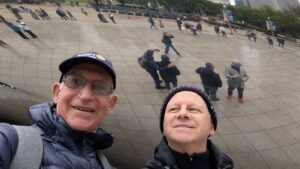
Pieter, who happens to be an engineer, was by now deeply impressed and inspired, and was busily taking pictures and playing with the awesome reflectiveness of the structure.
It is hard as a blind person to adequately portray or, frankly appreciate, reflection. Even as a person with low vision, many years ago, I was not able to really benefit from my own reflection in a mirror, so it is somewhat difficult for me to do justice to the stupendous scale of the Bean’s reflective quality.
But this is its true magic and makes one appreciate its original name “Cloud Gate”, which I frankly prefer as the name “The Bean” seems puerile and parochial to me.
It is essentially an enormous curved mirror with a surface area of more than 5000 square feet or over 480 square metres, which is twice the surface area of a tennis court. As a result it gives the impression of always being in motion because of the reflections of everything moving around it, people, vehicles, clouds and light, of course. At the same time, the reflection of the Chicago city-scape is constantly captured as well in a myriad different angles. Apparently, at night it is simply stunning in its reflective brilliance.
Once again, the tactile component provides a complex yet satisfying element to our ability as blind people to be able to appreciate such a beautiful sculpture. Even though one can only touch a tiny area no bigger than ones hand, its high polish, coupled with the description of its scale and reflective brilliance by sighted people around us, provide ample stimulus for a very satisfying experience.
I am so grateful that I did not miss Cloud Gate.