After my last blog-post about the ‘Perceiving freedom’ sunglasses sculpture at Sea Point I have been scratching my head furiously about what to write about next.
I have so many ideas and recent experiences of interesting installations and events that I am spoiled for choice.
But, as so often happens, inspiration came to me quite by accident and once again involved “the things we miss.
Friday, 21 March, was Human Rights day in South Africa, commemorating a particularly savage bit of Apartheid excess when police opened fire on several thousand unarmed and peaceful demonstrators, at Sharpeville about 70 km from Johannesburg, on the early afternoon of 21 March 1960.
At least 91 people were killed and over 230 injured. It turned out that most of the victims, many of them women, were shot in the back.
This event more than any other single incident fueled the fire of resistance against Apartheid oppression going forward.
One man, stood head and shoulders above most others in demonstrating resistance, courage and sacrifice in South Africa at the time.
He of course was Nelson Mandela. Who would be captured, put on trial and imprisoned only two years later, in 1962.
To cut a very long and complex story short, he was finally released after 27 years imprisonment, most of them on Robben Island, on 11 February 1990.
Which leads me to this edition’s feature.
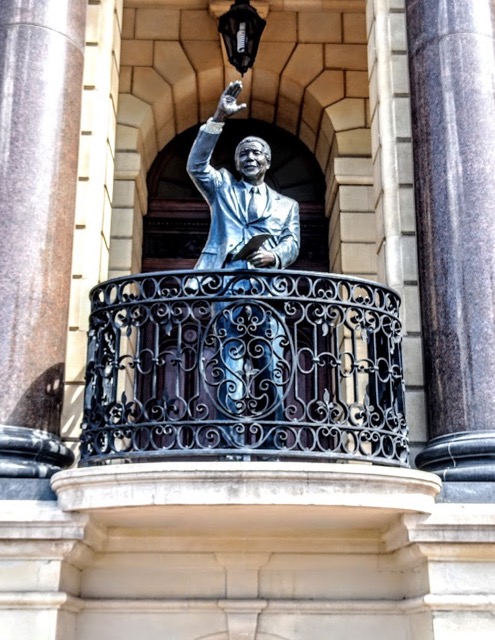
Standing on a podium situated on the grand front entrance of the southern side of the Cape Town City hall, is a magnificent life sized bronze statue of the late Nelson Mandela or Madiba as he was known.
The depiction is incredibly iconic , since it captures his address to the deliriously excited 100 000 strong crowd that massed, mostly on the Grand Parade but also, like this writer, found some vantage point on buildings surrounding the City Hall.
So, last week I had occasion to visit the City Hall to discuss their accessibility issues and opportunities.
Built in 1905, it would serve as the seat of Government for the Cape Province and Cape Town city for much of that century.
It is a beautiful and very ornate late Victorian structure made from sandstone which now is more famous for housing the wonderful auditorium which hosts Cape Towns premier musical community including the Cape Town Philharmonic Orchestra and many choirs.
So, while we were standing in front of the City Hall, one of the City officials I was meeting happened to mention the Nelson Mandela statue.
It has to be said that I do recall some mention of a statue of Mandela, but honestly had no idea where it was or what it depicted him doing.
So, as I do, I peppered the poor man with a barrage of questions about the sculpture.
I must give him credit for really getting into the spirit of the game as his descriptions were animated, colourful and very clear.
I must add , that it helped that I had a very vivid memory of that day back on 11 February 1990, since I had stood, with my fiancé, Jackie , seeing nothing much of course with my very limited vision, on the roof of the railway station several hundred metres away, but absolutely reveling in the almost electric atmosphere.
So, I had no difficulty picturing, as the sculpture portrays, Mandela at 72 standing on that balcony, with his right arm raised, not with a clenched fist as one might imagine, but with a looser open handed, almost gentle gesture of greeting and acknowledgement of the tens of thousands of people who had come from near and far to witness this unbelievable event.
He is wearing not one of his less formal Madiba shirts that would be his hallmark later on, but a dark grey suit, with one of the jacket buttons fastened. He wears a white shirt with a dark tie. There is even the traditional white handkerchief protruding from his breast pocket.
His left hand, which rests on the top edge of the balcony railing grasps his speech in a light grip, and one can even see peeping out between his thumb and forefinger, the lense of his reading glasses, of course, to be accurate, his wife Winnie’s reading glasses, that he had to borrow on the day, as he had mislaid his own.
His suit clad legs and formal shoes he wears in the sculpture are somewhat obscured by the ornate wrought iron balcony railing.
His face with closed mouth, and pronounced lines around the nose and mouth does not show his usual generous and ready smile that is so often portrayed in the millions of later images, but nevertheless hints at a smile ready to come. This is evident by the laughter lines etched around his eyes.
His short curled hair is still full and is beginning to grey.
This depiction of him is hugely significant as it must be remembered that this is the very first time that Madiba was seen by the public or the media since his incarceration in 1963.
Nelson Mandela served as President of South Africa from 1994 to 1999.
He is regarded as one of the most iconic statesmen of our time, not least because he managed to navigate South Africa through a potentially perilous time in our history employing prodigious wisdom and humility.
Madiba died on 5 December 2013 at the age of 95.
Jeremy Opperman has been a disability inclusion consultant since 1999.
Jeremy is a trainer, speaker, writer and passionate audio description enthusiast.
He is associated with South Africa’s leading Audio description company, Shazacin Accessible Media.