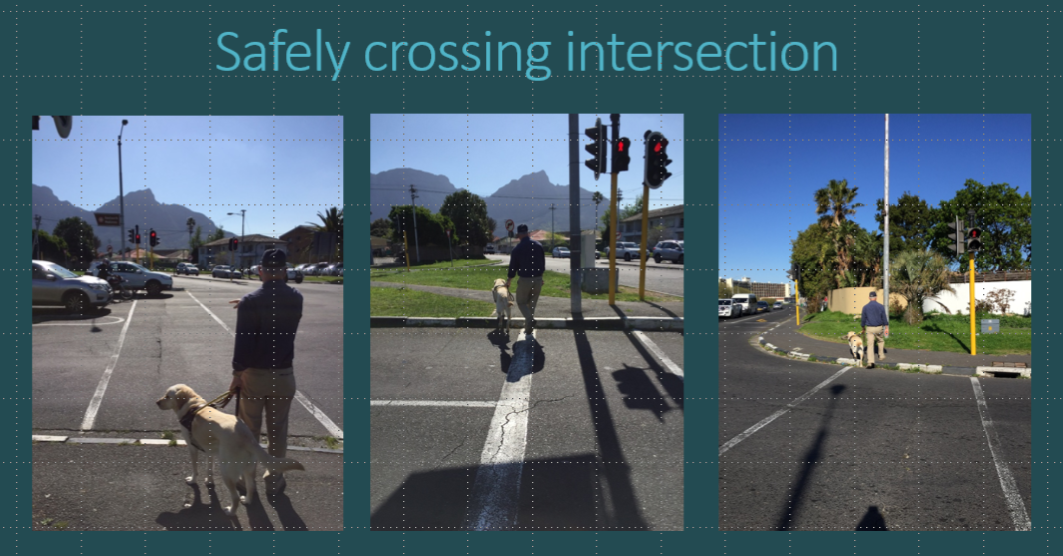
In Cape Town we are blessed to have a great many universally accessible, signalised intersections and crossings which include an audio or audio/tactile facility, which are useful for blind and even deaf/blind as well.
In fact, to the City’s credit, it is a matter of policy that audio signals are installed in any new intersection being set up or refitted. This means that for pedestrians, including the blind, in theory at least, crossing at intersections should be safer and accessible. However, this is not necessarily the case.
Notwithstanding the great many accessible signalised systems out there, a few serious problems exist, which are not considered unless they are put under a spotlight and interrogated.
It is this writers contention that most people don’t actually see the problems, unless they stop to consider the implications of crossing while being blind or being older etc.
Firstly, it must be borne in mind that pedestrians in Cape Town are inveterate Jay walkers. I suspect that this is the case everywhere else in the country as well. (This is tragically proven by the sheer scale of pedestrian deaths each year). This fact also casts a shadow on quality of driving in the country and drivers attention to rules and common expectations on the road.
In addition, almost all pedestrians are sighted.
What this means is that pedestrians crossing at intersections regardless of the signalisation tend to use their vision to facilitate safe crossing and don’t necessarily rely on the instruction to cross or not from the available signal.
On the other hand, the blind, and others less confident and nimble, such as people with physical disabilities, the old, or parents with small children, need to pay greater attention to the signal facility provided.
In this instance, the individual wishing to cross one arm of a four way intersection, would press the button on the pole and wait for it to make the appropriate sound announcing that it is now safe to cross. for the sighted, the green man will be shown on the opposite pole across the road.
Now it is a well-known fact that neither the green man nor the crossing sound, lasts very long, and so there is a level of urgency in making the crossing. In addition, there is a necessary degree of trust that must be employed to step off the pavement and begin the crossing.
This is where I must point out our first serious problem, and one that is rarely understood by drivers or pedestrians.
This is that the safety of the crossing is entirely dependant on the configuration of the traffic signal installed.
At the risk of oversimplification, there are two primary configuration settings on signalisation at intersections.
Parallel ped or Serial ped.
To explain this, it is necessary to imagine the intersection like the cardinal points of a clock. 12, 3, 6 and 9.
When the signal is set for parallel ped, this means that the instruction to cross, say the 3 o’clock arm, i.e., in the 6 12 direction, coincides with the moving traffic going in the same direction as the walker between 6 and 12 and 12 to 6.
In theory this isn’t a problem as long as the parallel traffic only goes between 12 and 6. But what happens when a vehicle turns from 12 to 3, or worse, from 6 to 3? The vehicle will be intersecting the path of the pedestrian possibly from behind, with obvious tragic potential.
Bear in mind here that neither the pedestrian nor the vehicle’s driver are breaking any law or rules. The walker is perfectly entitled to cross when told to do so, in fact for her own safety, she is required to only cross when told to do so. On the other hand, the driver, as long as it is safe to do so, is entitled to turn into the three o’clock arm of the intersection, but could be faced by a pedestrian lawfully crossing the road.
The walker is terrified and threatened by the menacing vehicle while the driver is angry at the tardy pedestrian in his way. By stopping so as not to hit the walker, the driver is now putting himself at risk as he is possibly in the path of oncoming traffic himself. It is not hard to imagine any number of tragic outcomes in this scenario.
Alternatively, when the pedestrian presses the button and the intersection is configured to Serial ped, the instruction to cross coincides with the stopping of all 4 arms of the intersection, allowing the pedestrian to safely cross the road.
I will leave it to the reader to conclude which of the two configurations are the safer for the pedestrian.
Sadly, however, with some exceptions in Cape Town, traffic engineers as a rule dislike serial ped as it interferes with vehicular traffic flow, particularly in CBD areas.
However, it is this writers opinion that this position is short sighted and outdated and must be carefully considered in parts of the country where insufficient attention has been paid to installations of accessible audio signalised intersections .See previous article https://disabilitydesk.co.za/2022/09/13/why-are-there-so-few-audio-traffic-signals/
There is little doubt that the pedestrian in modern times, for a variety of reasons is in the ascendancy.
In South Africa with greater emphasis being paid to non-motorised transport and more accessible public transport initiatives such as BRT services, it is axiomatic that there will be more pedestrians populating busy urban areas and needing to cross streets and intersections.
City officials need to pay far greater attention to this problem.