It is almost three years to the day, on the 9th of September 2019, that the late Deputy State Attorney, Webster Sekwati, was run over on Pritchard Street, in downtown Johannesburg, right outside the High Court, at a pedestrian crossing.
Mr Sekwati, by all accounts, was a humble, hardworking, and very competent lawyer. What is interesting is that the media made less mention of the fact that he was run over by a taxi clearly driving too fast or irresponsibly, than they did about the fact that he was blind. The inference seemed to imply that his blindness was somehow to blame for the incident.
Recently I have been doing a lot of thinking about non-motorised transport and traffic intersection crossing from a pedestrian point of view, and specifically pedestrians with disabilities.
Being blind and mobile, I am no stranger to having to cross every kind of road and intersection imaginable. However, living in Cape Town does make it safer and easier simply because we have so much more in terms of accessible signalised crossings than anywhere in the country.
When compared to Cape Town, where, to the city’s credit, accessible signalisation is extremely common if not quite ubiquitous, Gauteng and other provinces look like an access desert in terms of provision of audio traffic signals. In fact, it is not hard to find blind people in Gauteng that have literally never encountered such a thing.
On that note, for the sake of those who might not know what an audio signal is, let alone an audio tactile signal, and how they work, let me briefly discuss this.
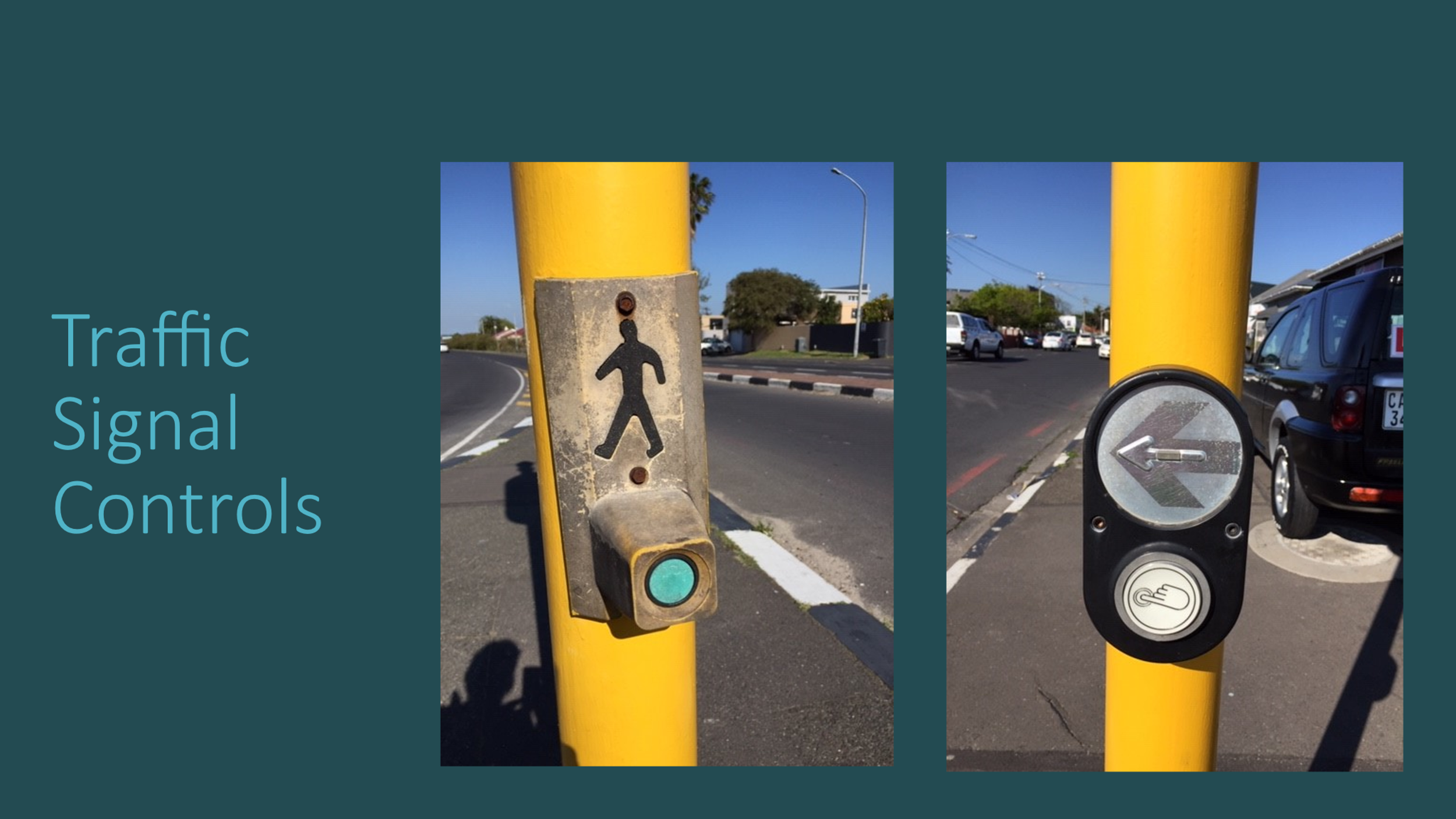
Audio signalling is a great example of universal access. This means that everyone benefits; people with or without disabilities. At an intersection or pedestrian crossing blind people find the pole, press the button, and wait for the tone to tell them that it is safe to cross. On the other hand, modern audio tactile signals are a wonderful innovation which assist blind people in finding the pole, because the pole also has a sustained tone to assist location, and the area around the button vibrates energetically when the tone goes off indicating when it is safe to cross. In addition, there is an embossed arrow on the pole that clearly indicates the direction to cross. This feature is more useful than one might think, given that so many corners at intersections are very rounded, and one cannot easily tell from the edge of the pavement, which direction one should cross towards.
In the absence of Audible traffic signals, blind people, who legally include visually-impaired people, have no choice but to cross the road whenever they perceive, usually by sound, that it is safe to do so.
In discussion with someone who knows that area well, and who has crossed Pritchard Street frequently, it appears that the traffic light, at the intersection of Pritchard and Kruis, was frequently out of order, which is an all-too-common occurrence in Johannesburg. This of course means that everyone crosses wherever or whenever they feel it is safe to do so. This clearly demonstrates that there is a clear demonstration of pedestrian demand of passage. This is not hard to fathom since that area is wall-to-wall legal offices, Chambers, and the high court.
In the past few years, there has been much activity toward ensuring that recently introduced BRT (Bus Rapid Transport) systems are more accessible in the Gauteng Province, which is commendable, and which includes not only looking at access for the busses but paying attention to the routes that travellers must follow. This has included a wide distribution of tactile paving that technically facilitate the safe navigation of these routes but, regrettably, does not include dedicated attention to accessible traffic signalisation. This makes no sense at all.
Unless far more attention is paid to provision of accessible (meaning audio) or audio tactile traffic signals at intersections and pedestrian crossings, accidents involving pedestrians including blind people will continue.
In closing it must be acknowledged that in South Africa, we have too many shockingly bad drivers who, frankly, terrorise our roads and who too often ignore traffic signals, but this cannot be a reason not to prioritise the widest possible installation of accessible traffic signalisations as a matter of urgency.